Casa Azul

Azul is the Spanish word for blue, which I expected to see lots of. However, I was a bit surprised to find that La Casa Azul was painted in a deep ultramarine blue rather than a brighter, more cheerful blue like cerulean or turquoise or even cobalt blue. It felt at times a weighty blue. El Greco would have approved. Nevertheless, if it is an actual reproduction of the color Frida and Diego chose for their home together, that blue is the perfect blue.


The much anticipated exhibit highlighting the garden, art and life of Frida Kahlo opened at the New York Botanical Gardens in May. As part of the presentation there were some very beautiful Mexican influenced pieces of jewelry, wares, woven items and other tchotchkes in the gift shop and even a display of traditional weaving done on site. A taco truck sat near the Moshulu entrance of the gardens and Mexican treats and drinks could be found in both cafeterias. There were also dance performances and live music by Trios Ellas and Villalobos
Brothers.


The library showcases paintings on paper and canvas including Frida's famous self portrait with hummingbird and twig necklace. Photographs of Casa Azul abound along with historical information of the life, times and areas surrounding this famous habitat located in Coyoacán, near Mexico City.


                                                     California poppies and cactus


You can't help but love California poppies, sunflowers and marigolds after viewing the display at the Conservatory and many garden designers may be inspired to add blue to their palette of garden furniture and planters.


                                                                            Hibiscus


Some of my favorite plant combinations were the container plantings in the outdoor water garden areas of the conservatory.


                                                                   Succulent succulents


                                                      Poppies in The Fence of Cactus


One may view the rich colors of yellow, terracotta and contrasting deep blue as reflective of the Mexican sun, wide open skies and also the colors of warmth, festivity, passion, pain and sadness, all of which were much a part of Frida's life and her tumultuous relationship with Diego Rivera.


The exhibit has changed a bit over the past months while remaining the same; always a glimpse into the life of an icon. I bet there are lots of Fridas on this Halloween night. Your last chance to see the show is nearing. It closes tomorrow, on November 1, Dia de los Muertos or The Day of the Dead. 


For the love of Sun and Bees


PLANT PROFILE: Helianthus


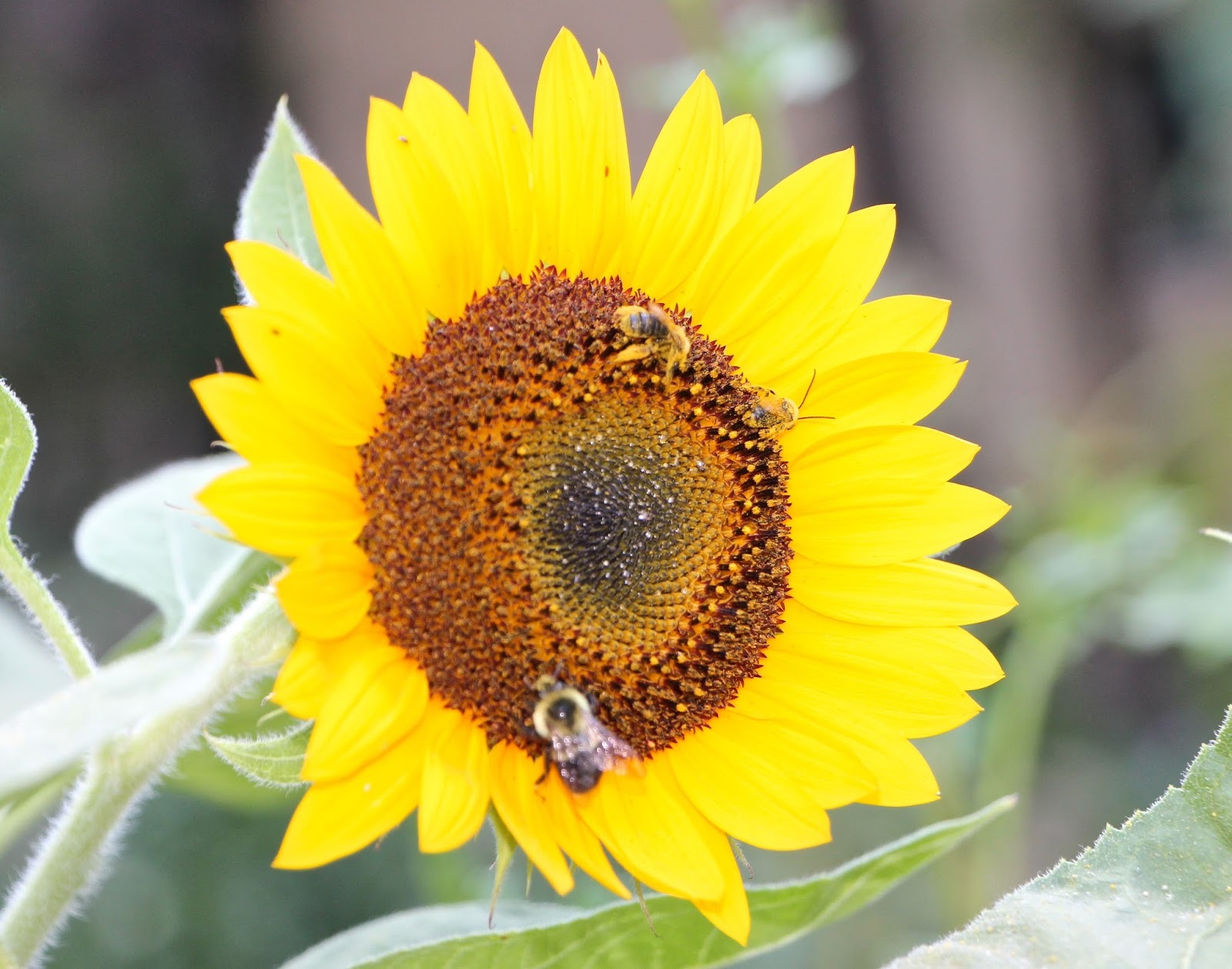
Bees absolutely love sunflowers. Dozens of happy bees feasted on the many I planted with the help of neighborhood kids in the Memorial Garden bed at Robert Clinkscale Playground and  Community Garden  on West 146th Street in Harlem. We grew Mammoth, Garisol Radiance Hybrid, Garisol Sunshine,  Italian White and Tithonia rotundifolia. Various species of bees just went crazy. Bzzzzzzzz, yummmhumm, bzzzzmmmmmm! Sometimes bees would become so dusted in pollen that they looked like soft brownish-yellow blobs hovering across the flowers. Some bees even followed the cut flowers I took out of the garden.


I tell children and adults who are unreasonably afraid of bees that bees are interested in pollen and nectar, not in humans, regardless of how attractive or nice smelling we may be. So unless you are doing something totally stupid like flailing and aggressively disturbing their feeding or messing with their hive, bees usually will leave you alone.


                                                              Be calm and let the bees be.


Sunflowers or Helianthus are in the family Asteraceae or Compositae. The family includes, aster,  daisy, echinachea, coreopsis and dahlia with each flower head containing numerous tiny flowers. Each flower advertises that it already been visited by a bee by loosing its brilliance.


A brown or brownish flower lets a bee will know to focus its adoring eyes elsewhere and pollinate other flowers. Each tiny flower in this round mass of pollen-covered goodness will produce a sunflower seed. If allowed to fall to the ground, that seed may grow into a sturdy plant with flowers to feed a generation of bees in the following year.


Sunflower seeds come from sunflowers. I say this simply because I was surprised  to find that many people do not know this seemingly-obvious fact.

                                                                   Tightly-packed seeds


No flower represents summer better than sunflowers with their cheerful brilliant yellow and contrasting brown faces, following the direction of the sun as the day progresses. Vincent van Gogh recognized the beauty of sunflowers and do did Frida Kahlo. Sunflowers are native to North America and a few are native to South America, like Tithonia. They are easy to grow from seed which make growing them a big hit with children. Sunflowers are not fussy about soil conditions but would do best in deep well-draining soil and they need at least six hours of sunlight to flower well.


Butterflies like Tithonia or Mexican sunflowers almost as much as the bees do. I often notice       butterflies and bees feasting on the same flower head.


Tithonia is very attractive and adds a bright orange color to the garden. Plants are multi-branching and flower prolifically until fall.


Italian White is really a creamy yellow sunflower. The plant is about 5' tall and is a multi-branch   form, producing many elegant flowers.

It is best to leave the flower heads to completely dry on the plants. The seeds mature well that way but they may also fall to the ground or get eaten. I hang some to dry indoors and leave the rest to the birds and squirrels. I have collected enough sunflower seeds to never ever buy another packet again and still have some to eat.

Email me at veronicatsanddogwood to send a self-addressed and stamped envelope if you would like me to send you some in the mail.


Some sunflowers like Mammoth grow to be more than ten feet tall. I like the shorter ones better as they are more in proportion to the size of the bed. Next year I will probably plant Tithonia, Italian White and shorter varieties of multi stem sunflowers.


Sunflower seeds make a healthy snack. They are also used to make oils. Since bees play such a huge role in keeping humans fed and sunflowers keep bees, birds, squirrels and humans fed, spread the happiness around by planting at least one variety of sunflowers somewhere every year.

Thank you bees! You are very welcome too. The pleasure is all yours and mine.


Dear Oliver


I did not know Oliver Sacks, well not really. His was the face and voice of one of many of us who attended the New York Fern Society meetings usually held on the first Saturday of each month at the New York Botanical Gardens. I have been attending for about twenty years and Oliver Sacks sat among us fern lovers and plants enthusiasts, sometimes with a notebook in hand and at other times with a cane. He often wore a t-shirt illustrating ferns fronds. During show-and tell he sometimes informed us of upcoming book releases and postings in the New York Times, the New Yorker and other publications. Once we were treated to copies of a draft of an article about Darwin that was to soon after be published.

Oliver Sacks did not know me, well not really. I had addressed the group only briefly on a few occasions over the years and just for a few minutes. Mine was one of the many faces among the group at our monthly meetings, albeit the darkest face and for many years, the youngest face (It is strange to acknowledge one's own aging only after noticing the aging of others). We all strained our ears and necks around poles and potted fern to not miss a word of the many presentations done in power point in the often crowded, dark room as group leaders John Mickel and Robin Moran and various guest speakers presented images and chronicles of expeditions and research. Many were botanists and all were passionate plant lovers skillfully and often humorously displaying their interest in and knowledge of ferns and non-pteridophytes. Carol Gracie was one such presenter. She showcased her book Spring Wildflowers of the Northeast and inspired me to someday publish a book of photographs, observations and ramblings of the naturalist and plant geek that I have developed into. Our annual pot-luck  meeting in December was always in attendance by members of the Society of Botanical Illustrators and by John from the gift shop, with copies of Oliver's books and many treats on ferns, fern allies and others on botanical illustration and plants in general. Oliver was available to autograph copies of his book with his signature green scrawl.

Our Fern Society group was the inspiration for Oliver's book titled Oaxaca Journal.  I began to know him through reading this book, through his articles and posts and later through Hallucinations and lastly through On the Move. The shyness and extroversion that Oliver wrote about in On The Move was not often displayed in our group meetings. When he spoke it was often with much charm, clarity and humor though I rarely saw him interacting with individual group members and he seemed a bit reserved. I remember being a bit shocked to hear him speak of the cover photograph of On The Move where he described himself as "young and sexy". Indeed he is just that. He is quite a stud, clad in leather perched on his BMW.

Oliver Sacks did not know me, not well enough and this I understood as he explained in one of my last encounters with him. I was contemplating graduate studies at Cornell University and mustered up courage to ask him to write me a letter of recommendation. Oliver was very polite and respectfully declined. He explained that he would have to get to know me before he could write such a letter and since we had not worked together and that I was never his student or  assistant it would take a time commitment that would not be organic or natural. I well understood from his writing that he was very selective about how and where his time was dispensed. I was a little peeved but understood. I was developing a bit of an online presence but since I had found out from his assistant years before that Oliver never used the computer, it seemed unlikely that he would ever read my blog posts, or look at my painting or garden design website online. If he did he would at least know a bit about me and on his own time, even if he never really got to know me. How does one know a person and what amount of time amounts to knowing them well? I never know and realize that I never knew people that I thought were close to me, even ones I had lived with for years. After that Saturday meeting Oliver and I exchanged smiles and brief hellos.

On March 7, the last day I saw Oliver, he was accompanied by an assistant who helped him up to the front of the group at our Fern Society meeting. The news of his diagnosis and then impending death was published just days before and he had so bravely come to the meeting to express his gratitude to the group for the many years of inspiration and excitement and to say goodbye. He was that kind of man; humble in his greatness. He explained that he first got an idea of his condition while in attendance at a Fern Society meeting earlier in February and realized that he was not feeling well. A trip to the bathroom indicated that something was seriously wrong and a subsequent visit to the doctor confirmed that his time was very limited. He would spend his last days with family and friends. I think everyone in the room silently cried.

I wrote a letter to Oliver hoping to see him at the following meeting, scheduled for April 11. Oliver never attended the meeting.  He was with his family in England and I decided to make no effort to intrude on his time.


April 10, 2015.

Dear Oliver,

I worked with Catherine to organize the summer fern foray trip to western Massachusetts that we made last June. We looked at ferns in and around the Hawley Bog, High Legends Nature Preserve, the garden of Elsa Bakalar in Heath and the garden of Jeffrey Farrel in Ashfield.  Jeffrey is my mentor and long-time friend and was our guide. He is also the gardener who worked with Elsa for many years and now preserves her work. I garden with him whenever I can and Elsa's old garden is one of my favorite places to visit in New England. A few years before her death the property was sold to a painter named Scott Prior and his wife Nanette Vonnegut, who is also a painter. Scott and Nanette are very friendly people and whenever they were around they would reward Jeffrey and I with lemonade as we weeded in the open garden beds, surrounded by acres of deciduous forest. On a slope just meters from the garden sat a small frog and newt-happy pond in which we cool off. Scott had painted many pictures of his wife and family in and around that little pond that seemed very unused of late. Not many members of the Fern Society group attended that trip to MA which ended with a visit to the birth place of Mary Lyons, located just down the road from Jeffery Farrel's home. I wish you could have been there.

A few days before the trip to MA Scott notified Jeffrey that you were a good friend Nanettes's father, Kurt Vonnegut, and was a regular visitor near the end of his life. How small is the world after all?

I do hope that the doctor's predictions are wrong and that you are able to join us for many more Fern Society meetings. Thank you for educating, entertaining  and inspiring us with your powers of observation, insight, wit and eloquence. It is my wish that you continue to live this extraordinary life you have been gifted and created for yourself and remain surrounded by people you love and who cherish you just as much.

Veronica


Oliver Wolf Sacks died on August 30, 2015.


September 6, 2015


Dear Oliver,

Many Happy Travels!

Veronica

Gumbo and Sass


As a food and culture enthusiast, I recently prepared dinner for a family visiting from France and decided that a New Orleans style dish would be fitting. The word "gumbo" is of West African origin and was used to describe a dish of ochro ( sorry, I am from Trinidad and "okra" spelling and pronunciation is a very American thing) and rice. Below is a list of ingredients for my seafood gumbo.

shrimp, cod filets, smoked Andouille sausage
ochro (or okra), bell peppers, celery, onions, garlic
parsley, dried thyme, green onions
chicken broth, water
bay leaves (which I forgot to put in)
cayenne pepper, salt and black pepper
canned crushed tomatoes (although not necessary)
oil and flour for the roux

The roux was cooked until it looked like a reddish milk chocolate but got darker after I turned the heat off, with the heat from the cast-iron skillet. Roux is the base sauce of gumbo and of many French dishes. My mom makes a wicked light roux for macaroni and cheese, with grated onions, a splash of mustard and a tablespoon of Worcestershire sauce added in.

Chopped onions, peppers, celery, garlic and herbs were sauteed with sliced sausages and ochro then added to the roux.  Tomatoes, water and chicken broth along with salt pepper went in next and the pot simmered for about 30 minutes before I added the shrimp and cod, about five minutes before serving. I garnished with chopped parsley and scallions and served the gumbo with rice. I only had brown basmati and jasmine and went with jasmine.

All of the above were easy to find in my Harlem neighborhood except for the Andouilli sausage which I got from Whole Foods on West 24th Street. The missing ingredient was Filé Powder which should be added to the gumbo after the heat is turned off.

Trader Joe's directed me to Whole Foods, though the employees there had never heard of filé powder. I resorted to approaching random strangers on the streets and groceries and harassed a few friends and acquaintances that I ran into around Harlem, asking where I could find some. I thought for sure that with such a large portion of Harlemites of southern roots, someone would know where to find filé powder. Mais non. Rien! Although they had eaten or even cooked gumbo before, almost everyone had not heard of it. Some suggested substitutes but with none knowing what filé powder was made of I realized the futility of my inquiries. I thought of Fairway Market but alas, too late. Five supermarkets and one hour before my guest were to arrive, I gave up.

Filé, which is pronounced "Fee-lay" is powdered leaves of the sassafras tree. Sassafras albidum is a small tree or large suckering shrub native to Northeast America. All parts of the tree are fragrant and spicy and it was used by Native American tribes for treatments of numerous ailments and to flavor and thicken stews. With its pungent fragrance and mitten shaped leaves sassafras cannot be mistaken for any other.


                                              Sassafras at the Native Plant Garden, NYBG


The leaves turn brilliant orange-red in fall and you cannot miss the spectacle of sassafras en mass. Sassafras grows in colonies and you may wonder what aroma your nose is detecting as you brush past them at Brooklyn Bridge Park or on the HighLine. Some chemicals found in the leaves of this fragrant plant are mood enhancers so don't be surprised if you find yourself suddenly or unusually happy while walking along. The root of sassafrass is also used to make root beer. Powdered sassafras leaves or filé powder adds thickness and viscosity to gumbo, soups and stews, sort of like ochro but the taste and effect of sassafras is unique and cannot be substituted. Sassafras adds flavor and spice and makes everything nice, irie even.


                                     Seafood Gumbo sans powdered Sassafrass leaves or Filé Powder


Dinner with my lovely guests was quite good despite the absence of filé powder. I have since then tracked down some and will be better prepared for the next gumbo, possible daring to try one with crabs, oysters and crawdads. A gumbo with sausage and chicken sounds good too. Any way you make it, this continental dish of of African, French and Native American flavors is absolutely worth trying. I may attempt making some filé powder myself from sassafras leaves collected on my next trip to the countryside. You can find filé powder online. Zatarain's makes it and yes, it is usually sold at Fairway.


Passion, Fire and Ice

Valentine's Day at NYBG

The Walk


Passionflower


Red-twig dogwood


Witch-Hazel


Artificial floor lights set this flowering aloe aglow.


                            Croton


Palm


Prickly Pear


Bright Beginnings


Dear Readers,

Thank you for reading my blog posts this past year. I really appreciate your comments and feedback on and offline. Wishing you a prosperous, healthy and productive new year filled with love and happiness.

Cheers!
Veronica


DAYS LIKE GRASS, ART AND GARDENS


As for man, his days are as grass: as a flower of the field, so he flourishet.
For the wind passeth over it, and it is gone; 
and the place thereof shall know it no more.

Proverbs 103: 15, 16
(Kings James version)

I grew up in the Church. My sister (Stephanie) and I sang gospel duets and solos by Skeeta DavisBJ ThomasMahalia Jackson and Jim Reeves in churches across Trinidad. At the age of eighty-one my mom still leads song services in the little Church-Of-God in Rio Claro. My brother Gregory, played guitar in Church. He masters acoustic, electric and twelve-stringed guitars, cuatro and mandolin and plays in parang bands. He also sings with the most amazing voice, which is a big hit at weddings. Gregory and I were both baptized on the same day when he was eleven and I nine, in the presence of  hundreds of witnesses. Although I may no longer adhere to the doctrines, the Church has had a huge impact on the way I live my life. Somewhere in my childhood the above passage became a favorite of mine. It still is.

Grasses are also woven into my past. For many years my mother foraged deep into the forest and returned home bug and leech-bitten, exhausted and happy supporting a huge bundle of hollow reeds, enclosed by one arm on her shoulder. Those reeds were laid out to dry until golden brown and later braided into mile-long chords then made into intricate rugs. Rolling fields of sugarcane with their fluffy plumes were part of my everyday surroundings for all the years of my childhood in Trinidad and Tobago. It was for the harvesting of that tall grass called sugarcane or Saccharum officinarum that Africans were enslaved on various Caribbean islands. I am the descendant of slaves. As a teen I made portraits and paintings and drawings of sugarcane fields and clumps of tall bamboo near reflective pools of water with  leaves sailing by. Later I lamented the loss of those plumes as the sugar industry crumbled. Slavery, displacement, land ownership, resistance to and connections with agriculture, poverty, wealth and cultural shifts are all wrapped up in the history of the sugarcane and of the people of Trinidad and Tobago. It is my history and a bit of this info is often present in my paintings.

Strong linear profiles in plants have always appealed to me, yet, despite their skinny frame, goldenrod was a loathsome species. It was because I needed to clear many thousands of them from a meadow in order to plant a garden near a little house in the woods on East Buckland Road in Massachusetts many years ago. Goldenrod reproduce by rhizomes and I found it best to pull each one by hand but soon discovered that once they start flowering those buggers hold on to the ground. After pulling them for weeks on end, I became tortured by all things yellow and despised yellow-flowering plants. Yellow became the crassest of colors.

Then, one day, in spring I suddenly loved goldenrod. I realized that I love the way they died. Their stems were buried in winter and after the thaw what was left were thousands of bleached crisscrossing straw-like masses. There was a random quality and chaos created when the stems fell willy-nilly in small and large clumps at varying angles. The effect to my eyes was one of currents, rhythms and fractal energy. Those elements embody change and the passage of time which I often detect in nature and parts of natural objects. As much as God may be in the details, God may often be in the generalities and atmosphere. I found that I was increasingly captivated by landscapes, aerial photography and tensions created in small and wide natural environments.

Linear marks found in nature, like ones made by goldenrod, bamboo and sugarcane continually enter my abstract paintings which have been called 'field paintings' because they have no main focal point and seem to extend beyond the ends of the canvas. They can be viewed as a small section of a much larger, more infinite space. Almost all my paintings are untitled. However, titles like "Field", "Currents" and "Days Like Grass" were attached to paintings created between 1995 and 2005.

                                               Currents, 2003. 48"x 36",  Mixed Medium on Paper

                                           Days Like Grass, 2001. 80"x 32". Oil on Canvas

                                                   Field,  2001. 32" x 30", Mixed Medium on Board


                                                      Untitled, 1995. 48"x48". Oil on Canvas


                                                     Untitled, 1995. 48"x 48". Oil on Canvas

It is no wonder then that when I first discovered the field-like plantings of Piet Oudolf I almost gasped for breath. I could not believe my eyes. I was mesmerized not so much by the colors but by the depth and movement created by layering of colors and texture and the rhythmic quality produced by linear plants, stacked vertically creating horizontal ridges and plateaus with their massed umbels, spikes and seed heads in increased depth of field. I remember excitedly showing an image of Piet's work to a friend who immediately remarked, "This looks like your paintings".


                                         Piet Oudolf planting design on the HighLine, summer 2014
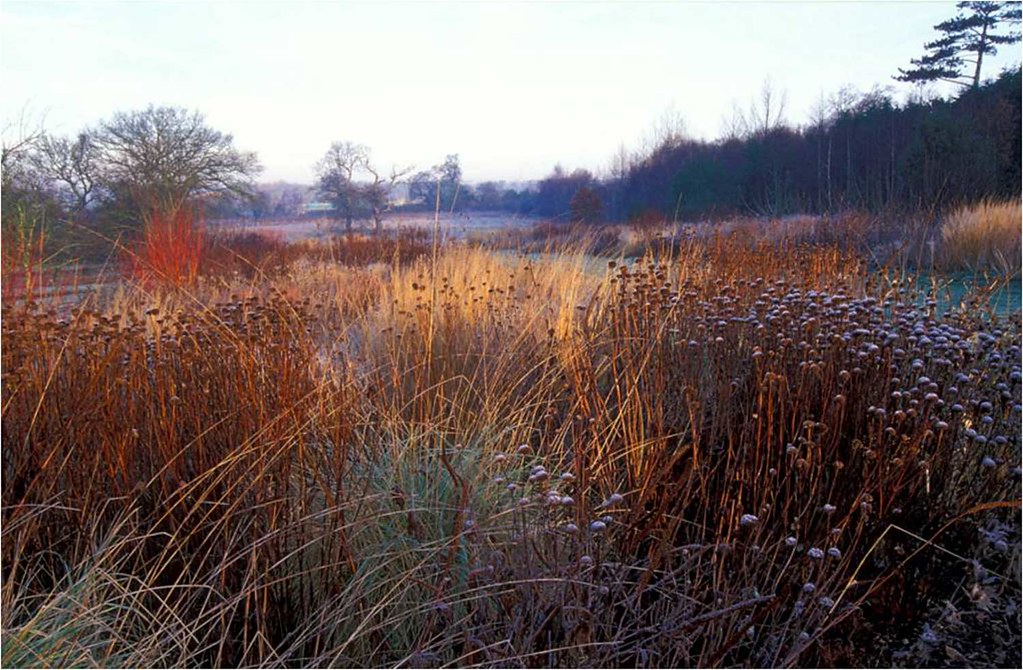
Piet Oudolf planting at Wisley, England. Possibly my favorite image of his work.
Piet has revolutionized the garden design world with his vision of naturalistic style of         planting that are reminiscent of North American plains but with a planned randomness that would hardly place them amongst wall paper. The sheer scale of many of his plantings and the masses of varying colors and textures are dramatic living visual fields of plants en mass that look like giant canvases; art that one can jump into and interact with. Then too these paintings move, change color and depth with each passing hour, day and season. As time shifts from autumn to fall and from fall to winter the short-lived colors of blossoms give way to opulent earthy worlds of ochre, burnt sienna, sepia and amber; almost monochromatic designs. Before our eyes are transforming environments subtlety ushering us into the days and months to come.

Piet's meticulous attention to understanding individual plant morphology as they age and are affected by rain, frost, snow and light, and his skill at timing the various stages of their lives  with other similar and contrasting plant combinations is also remarkable. Seed heads of flowers and grasses create semi transparent screens, washes and glazes. Seen close-up each flower or seed head commands its share of importance. The artist selects plants whose structural details make us wonder at the magic of creation, such as those revealed in the photographs of Karl Blossfeldt. On wider scales and experienced at various angles, colors, shapes and textures are combined to cause our eyes and minds to meander and pause. Sunlight, fractured through tall seed heads often create cathedrals and sublime garden atmospheres. The plantings transform moods similar to the way a horizon line or a jagged shape calms or jars us, but always draws us closer.  Piet Oudolf's designs contain layers of complexity that inspire emotional reactions, slow us down in awe and inspire the most reluctant of us to create connections with nature.

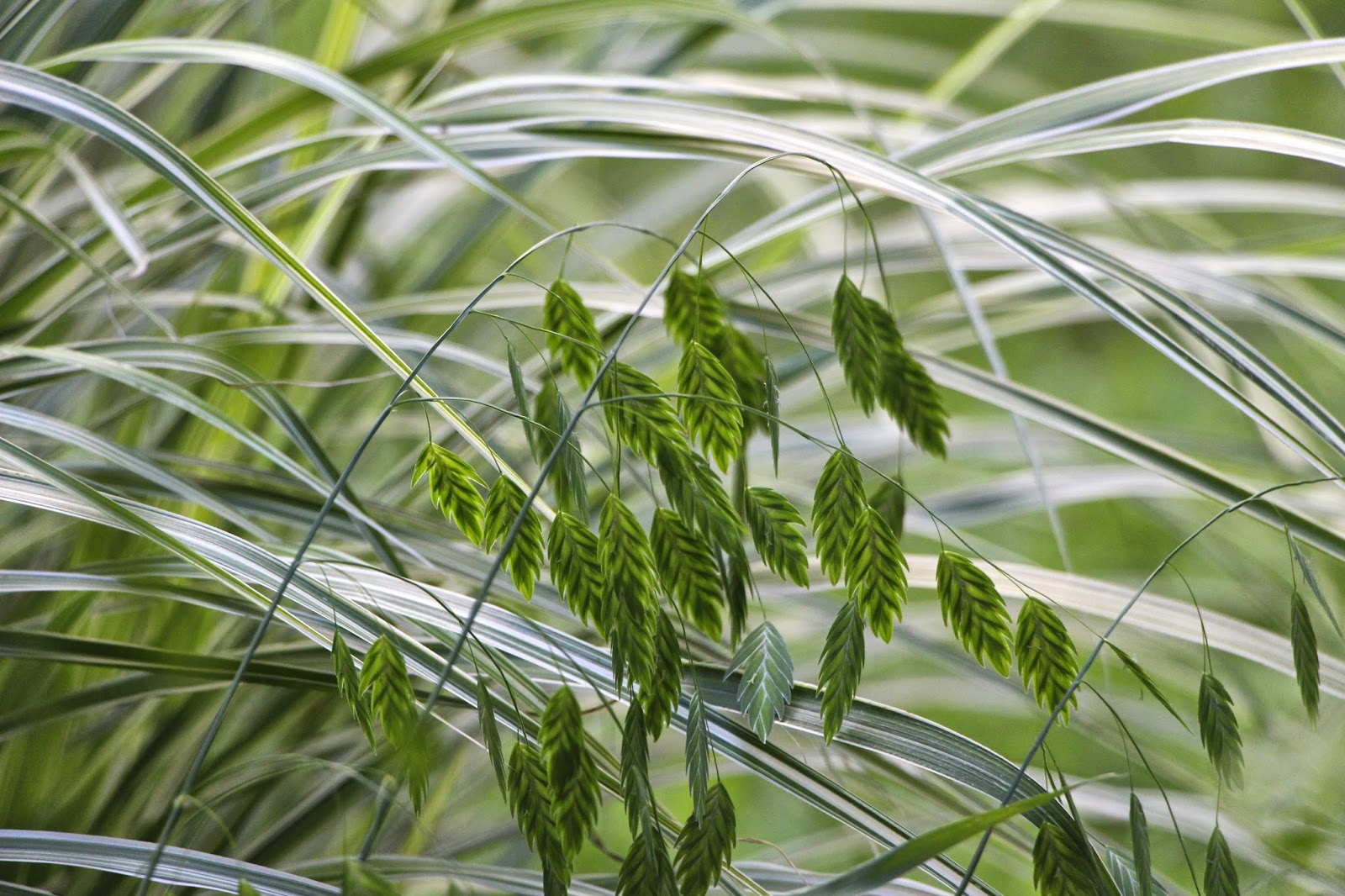
The pizazz is largely due to the use of various fine-textured, tall and short grasses, which when green or dry act as backdrops, borders or dividers for stronger colors and as filters for light. Blocks of colorful umbels and upright or crooked spikes are framed by pools of Molinia, Deschampsia, stiff Calamagrostis x acutiflora 'Karl Foerster', feathery Stipa and Panicum. Grasses shimmer, flop, arch, fan, spray, obscure, soften, divide and unite Piet's designs. Then too they make their obvious progression from green blades to seed heads and plumes to dried blades, moving all the while, making their presence, aging and disappearance pronounced. They are the common thread that zigs and zags throughout the designs of Piet Oudolf. Grasses display their dried seed heads and leaves which hang around during winter, creating interest and movement in what can be the most depressing time of the year. Grasses, with their light and whimsical quality, brighten the fall and winter landscape and also provide food and shelter for birds, insects and other small creatures when very little else is available. Gotta love grass.

      Lobelia cardinalis and helianthus enclosed by switch grass at the Native Plant Garden, NYBG


                                           Untitled, 1995. 18"x18", Mixed Medium on Canvas

Time is an important aspect of Piet's designs, not just in his desire to have the viewer experience the garden as it matures over the years but to impact the viewer throughout the life cycle of each plant. As the foundation of his designs, grasses best convey the ephemeral quality that defines his gardens. They are fleeting. They are emblems of frailty, beauty and transience. I dare say that they echo our own frailty, beauty and transience. Beauty itself elicits joy and sadness at the same instant because we know it is always momentary. Although I would not call them memento mori, grasses reminded the author of that passage in Proverbs that we are just here for a while, blown around by the vagaries of fortune and gone in a second. This thought should humble us and inspire some urgency to live well. If we think of our presence as short-lived as grasses, we would probably live more fiercely, more purposely and exit each phase of our lives and this world leaving positive impressions.

 
                                           Untitled, 2003. 24"x 24",  Mixed Medium on board

Just as nature has influenced my paintings, elements of my art-making have leaked into the gardens and planting I design. When conditions are ideal I include goldenrod and I have a weakness for Miscanthus sinensis 'Morning Light', Carex flacca, Hakonechola macra 'Aureola', Calamagrostis brachytricha, Chasmantium, Pennisetum, Stipa and Panicum virgatum.


                     Miscanthus sinensis and Chasmanthium latifolium in the West 148 Street Garden


                     West 123 Street planting with Panicum virgatum, Stipa, Miscanthus and Molinia

The way I design plantings has also been impacted since encountering the work of Piet Oudolf. I met the artist and garden designer in November of 2012 while working as a seasonal gardener at Brooklyn Bridge Park, just days after Hurricane Sandy. He stopped by as I was in the midst of installing fencing around a bioswale filled with grasses and asters. It was a very brief meeting and as we shook hands I thought it strange and weirdly comical how we met as gardeners while I felt we shared a deeper connection as artists. He never guessed how ardently I admired and respected his work.

I still sing a lot. Mostly I sing folk, rock, calypso, Fela, Tolonec and gospel songs, especially while I garden or design. Gardens, plants, plants as habitat and human interactions with plants occupy my thoughts throughout these days like grass and I spend much more time as a garden designer and gardener than as a painter lately. I can only speak for myself when I say that the two titles, the two passions, united in a love of beauty and intrigue of the natural world are rarely ever independent and most often, inseparable.


Robert L. Clinkscales Playground and Community Garden Opens

Last Monday, September 29 was a perfect and unseasonably warm Fall day and it marked the official opening of the Robert  L. Clinkscales Playground and Community Garden on West 146 Street in Harlem. This project has been long in the making and many turned out for the auspicious event attended by a range of dignitaries, politicians and community activists as well as the family of the community activist and advocate for whom the project is named. Robert Clinkscales, who passed away in 2001 was the champion  responsible for the revival of Jackie Robinson Park and for the development of many housing and outdoor projects in Harlem.


 Senator Bill Perkins, son and wife of the late Robert Clinkscales and Parks Commissioner Mitchell J. Silver


Former Council Member Robert Jackson, NYC Parks Commissioner Mitchell J. Silver and Assembly Member Herman D. Farrell


                                       Testing one of the water features in the playground area.


The community garden and playground is an ambitious project encompassing five city lots and outfitted with ramps, a sunken sand box, a play area with water features, a storage area and ample seating. I spoke with the landscape architect, a young man from Manhattan Capital Projects group. The layout of the planting beds was meant to mimic ones that were there in the space many years ago. There are twenty planting beds of varying heights to accommodate persons of different physical abilities. Gardening for wheelchair-bound residents is a possibility. Paths are made of crushed stone aggregate that would provide some drainage but heavy rain is meant to drain towards the west side of the space with its obvious lower elevation. There is no designated composting area. However, areas planted with ground covers or covered with mulch could easily be used for composting or for additional planting beds. Also, there is no sheltered area for gatherings, but, with the aid of organizations such as GreenThumb, this and other amenities can be added.


What appears to be a large pergola stands without horizontal beams at the top. I imagine this area can be covered in grape vines, honeysuckle, clematis or other ornamental vines and translucent roofing.


The opening of this community garden and playground is a cause for celebration. Many residents (myself included) have been patient and eager to add their names to a list, any list that may get them close to securing an area to grow vegetables and herbs. There is an early childhood center just across the street and beds will be allotted solely for their use and others for older children. It will be interesting to see how the other beds are assigned. Hopefully, by this time next year the space will be hosting workshops for preserving food and teaming with gardeners harvesting the last tomatoes, performing early Fall chores and planting cold hardy crops.

This garden and playground is another example of a few working for the benefit of the community. With most of the city's vacant lots located in Harlem, there is hope that other such spaces will be withheld from developers and transformed into spaces that connect and strengthen Harlem communities. Thanks to Robert Clinkscales, community activist like Frederick Wilson and to all who worked tirelessly to make this dream a reality.


AFRICAN RICE IN NEW YORK

  While standing in the long line outside The Hungarian Pastry Shop near Columbia University, I was approached by a man who asked if I could...