Jeff's Garden in June


Papaver


Iris


                            Petite blue Veronica


Paeonia


Omar
Henry is nearby somewhere. Jeff is happy to let them roam about except when they are nibbling on things they know they should not. They graze on some invasive bamboo that grows among milkweeds and daylilies on the slope between the house and the gated vegetable and flower gardens. I bet Jeff wishes they ate mugwort and mint too.


Lots of frogs live here with a pond just behind the flower garden. The pond is almost hidden by masses of petasites.


                      Salvia, Emilia and Agastache

These pots of flowers are magnets to hummingbirds that visit each morning and at the end of the day. Agapanthus will join in soon.


Tomas


Pollinator and Eco-Habitat Gardens


Scientist and naturalists are concerned about the drastic decrease in the number of monarch butterflies that arrived in Mexico last winter; numbers that have been slowly declining for years but are now at an all-time low. Deforestation for farming, housing and for beautification of highways and public spaces and the prevalence of pesticides are all working together to weaken the immune systems of monarch butterflies, starve them and destroy habitat and host plants for their young. It takes a whole lot of nectar to nourish butterflies as they fly from Canada to Mexico and they need flower motels and other stop-over areas in which to refuel and plants to start their families on along the way. The same food and accommodations are required on their return trip when temperatures warm up in the north. The disruption in this natural phenomenon is significant because insect pollinators play a huge role in our food production. It is also significant since butterflies are considered the most graceful (and the least feared) insects and provide the awesome spectacle of beauty and wonder as mass numbers take flight each year and their breath-taking congregation in Mexico. However, other less adored species of insects, their food supply and host plants are also being similarly affected along with birds and larger animals. Disruptions in the numbers of monarch butterflies signal disruptions in our entire ecosystem and we all should be very concerned.

As a child growing up in Trinidad I witnessed similar migrations of Urania leilus or the daytime -flying swallowtail moth, which we called 'police butterflies'. There would be hundreds of these blue, black, green and white lovely creatures laying with tattered wings on sidewalks and along country roads as swarms made the journey to and from the mainland. Hardly anyone I speak to today recalls these migrations and no one remembers when they ceased.

This Spring I worked with students at PS188 in Coney Island to create a garden to attract butterflies, birds and bees. Our May classes focused on the anatomy of a flower and how insects and birds are attracted to and pollinate them. We made paper flowers detailing both male and female parts. How marvelous is the natural world and how incredible that every shape, color, line, texture and scent of these enticing floral creations is meant to attract pollinators and distributors, including humans to them. It is a simple fact that the main goal of all species is to survive by constant reproduction, even though it may seem like the sole purpose of survival of one species is to nourish another. Our morphology is meant to attract mates and create offspring. I couldn't help but notice the awkward moments amongst students when I talked about the male and female parts of the flower. Fertilization of flowers, even aided by butterflies birds and bees, is sex talk.

In June we briefly covered the life cycle of the butterfly, their quirky habits, their predators and defense mechanisms. We also discussed how to behave around bees, welcome visitors to the garden and the not-so-welcome visitors, wasps. While many wasps are great pollinators, some prey on butterfly larvae. It is not so easy to love wasps.

Our major task was planting hundreds of native plants from Prairie Nursery. Larger pollinator-attracting plants and shrubs were planted earlier and plants from seed were started indoors. All came together to create our brand new pollinator garden. Students read the descriptions of various plants and enjoyed trying to pronounce the scientific names. Some star plants do double and even triple duty, attracting butterflies, hummingbirds, song birds and bees. Liatris ligulistylis, Asclepias tuberosa, Monarda fistulosa and Echinacea purpurea are star attractors.

              Partial pant installation in early June in the small garden with narrow crisscrossing paths


        South side with guys from the YWCA after school program working in the vegetable garden site

Tubular flowers were designed to accommodate the long beaks of hummingbirds who reach deep within to sip tasty nectar. Hummingbirds love red so we planted flycatcher plants and columbine, both orange-red. We also started cypress climber, which have interesting finely cut leaves and bright red tubular flowers (although the vines were stolen when they were about four feet up the wrought iron fence). Other flowering vines like Mina lobata and hyacinth beans were started from seed. Climbing nasturtiums were started under grow lights on the fifth floor and did just as well as ones started in the garden. Salvias are some of my favorite plants and a major attractor of hummingbirds regardless of the color. We have red, pink, blue and purple salvia. Plants for song birds include switchgrass, prairie dropseed, little bluestem and Mexican sunflowers. Ilex verticillata is in place to provide birds with berries in winter. The showy red berry display is also a good reason to include these shrubs. One large tree, a young honeylocust, stands in the garden. As spring proceeded, it became clear how badly it was damaged by Hurricane Sandy. It may be removed and possibly replaced by a shad bush or another shrub that produces berries that both kids and birds will love.

Bees love purple and blue although the centers of many of the flowers they are drawn to are yellow.
Butterflies are not too picky about flower color and will flit about on many although each species has its favorites. We planted Joe pye weed, tons of Echinachea purpurea, E. pallida, E. parodoxa, sedum, rudbeckia, eupatorium, iron weed, culver's root and several species of asters to provide fuel to monarchs during their fall migration to Mexico; Monarda didyma and M. fistolusa, goldenrods, penstemon, liatris, agastache and of course, lots of three species of milkweed. Monarch caterpillars feed exclusively on milkweeds. Rattlesnake master was included for its unique foliage and flowers and for the love of saying the names (both scientific and common).

Many gardeners are caught up in the 'Native Garden Wave'. It makes perfect sense to plant native plants to attract insects and birds since native species of insects and birds have adapted and evolved along with their food and habitat plants. Restoring habitats of native plants to increase the population of monarch butterflies is of major priority. However, like New Yorkers, many birds, bees and butterflies have cosmopolitan diets. The success of their intercontinental flights depend in it. Some have adapted to and often delight in foreign cuisines like Peruvian nasturtium and Mexican sunflower which are welcome immigrants to our almost-all-native pollinator garden and are butterfly and hummingbird magnets. Butterflies love zinnias which are also from Mexico. I noticed bees visiting the tiny flowers on the Ilex crenata, a Japanese native. And what American garden does not include a bit from the Chinese? Buddleia davidii is a native of China but very reliable when it comes to attracting butterflies. Simply put, butterflies consider buddleia the bees' knees. Verbenas are a hit with butterflies and tall, airy Verbena bonariensis is from Brazil. Perovskia atriplicifolia or Russian sage attracts bees, bumblebees and hummingbirds. It too has its place in the garden which, though consisting of mostly true natives, is as diverse as the community in which it sits. Go native please, but be practical.

Habitat gardens that look like a little field or like something from a 'Garden by Numbers' box seem to also be the trend. Maybe it is the influence of native plant catalogs and the notion that butterfly gardens should be wild and weedy. This garden is an outdoor classroom to inspire and entertain but gardens are nothing if they are not beautiful and organized, even in their seemingly random states. That said, I design and plant with beauty, order, structure and form in mind so that children and adults can be drawn into the space and be mesmerized by individual plants, plant combinations, colors, shapes and textures, even as they observe caterpillars devouring leaves and entire plants.

Beautiful foreigner that it is, Cotinus coggygria 'Royal Purple' stands out in the garden. The burgundy leaves echo the color of the recently constructed school gymnasium which is very modern compared to the main school building. I intended the garden itself to reflect the sensibility of the new building with neatly laid out gray gravel paths bordered by steel edging. However, this is a dream at the moment since the budget did not allow for the required materials. Shredded bark will have to do until some kind contractor with welding and steel-bending skills will do it, gratis. Cotinus acts as a great structural plant amidst wispy fennel, agastache and steel blue panicum. And yes, I included boxwood. Two rows of little boxwood act as barriers and guide visitors to step onto the narrow paths as they enter the garden from the north or south sides. Boxwood and the three very upright and narrow Ilex crenata 'Sky Pencil' are already hiding places for sparrows and would provide welcome shelters in winter. Little boxwood were also included in the vegetable garden constructed a few feet north of the habitat garden. I never forget that I am planting with children in mind and the evergreen spheres that clipped boxwood create and fuzzy lambs ears are a playful contrast to grasses and masses of prairie natives.

The garden space was meant to utilize rain water runoff from part of the school building and there is a rain water collection area in the vegetable garden too, adding sustainability of both gardens. It is very cool that the architects thought of this! Rain water can be used to water vegetables and minimize water use in the pollinator / habitat garden. Water attracts wildlife and the plan is to invite them to make this garden their home or at least visit often. A tiny, shallow pool can easily be created to attract frogs and possibly dragonflies. This will be a great project to do with the kids. A spot is reserved for a simple birdbath and a nectar feeder for hummingbirds will be installed (Donations Please). Enticing butterflies with a shallow drinking spot and mud puddle are quick and easy projects. With these features in place, PS188 will officially be the site of a Coney Island Eco-Habitat garden. There is a sizable compost area in the vegetable garden. With a few changes like the collection of lunchtime vegetable and fruit scraps for composting and replacing Styrofoam lunch trays with bio-degradable cardboard ones PS188 is on its way to becoming an Eco-School.

We are done planting! Asclepias syriaca and Helenium 'Moerheim beauty' from North Creek Nurseries were last to go in the ground. Three small patches of white, pale and dark blue Siberian irises, a light pink monarda and a few common milkweed made it on a bus trip from Jeffrey Farrell's garden in Massachusetts. They overnighted in Harlem and are now residing in Coney Island. Brilliant red hollyhocks, red velarian and two lovely pink dianthus were picked up on that weekend trip in MA too. Rose malva, pink geranium, blue columbine and a small clump of variegated miscanthus were schlepped from the West 148 Street garden in Harlem. A couple bamboo trellises are still to be installed for Clematis virginiana and a honeysuckle that was labeled as rust orange but is really a pale yellow. Ugh! Do you think hummingbirds will care that the flowers are yellow and not orange?

The garden is mostly green still. Three very sturdy and long-flowering allium 'Globemaster' and Baptista australis of a similar shade of blue are now spent. Columbine, salvia, yarrow, malva and lantanas are blooming while buddleia and coneflowers are gearing up for the show. When students return in September, purple coneflowers, monarda, rudbeckia, goldenrods, ironweed, agastache, eupatorium, liatris, salvia and buddleia will be in bloom; a veritable butterfly smorgasbord. Soon after, asters, heleniums and seedheads of panicum will take over until holly berries appear to hold the fort through winter along with coneflower and monarda seedheads.

Butterflies, bees, hummingbirds and songbirds are our special guests. You too are invited to observe the first batch of caterpillars. The little globes found on dill and bronze fennel were butterfly eggs. So on the last days of school before summer we headed to the garden with hand lens and magnifiers and spotted three little caterpillars with a white band across their middle. They may be larvae of the Black Swallowtail butterfly. As they grow larger we will be a better able to identify them and know what butterflies (or moths) they will morph into.


The garden at PS188 is meant to be a learning environment, an oasis and one more stop over spot for many generations of butterflies and hummingbirds. It is to delight curious children in Coney Island (a community that has grown on me) for generations to come, even the ones starting a new phase in their lives by proudly heading off to middle school. I will miss them. I root for those brainy, zany kids on their journey and for the monarchs too. Rah! Rah! Rah! Cheers!

To Love, To Eat, To Garden


One highlight of 2013 was a visit to North Hill Gardens in Vermont. The carefully crafted landscape is a work of art, love and labor spanning decades of collaboration between Joe Eck and his late partner, Wayne Winterrowd. On that day of my visit with Jeffrey Farrell and my then thirteen-year old son, Julian, it was overcast and leaves were still a bit droopy from earlier showers. Apart from the two shaggy dogs that greeted us at the entrance, we were the only ones in the garden. We were delighted with lush hills and valleys of large and small beds divided by winding paths and steps. We trekked over a small stream and under rustic pergolas. Elegant stewartia flowers littered the ground as we descended one path. We could not walk past the masses of peach, coral and orange primula without being stunned at the unreal blend of colors. Julian befriended a frog sitting among the juncus grass in the rain garden. It sat perfectly still while we goofed around with our hands within and inch of its face and only moved when I tried to grab it for a kiss. Goldfish swam in a barrel near potted plants in the little greenhouse supported on one side by a low stone wall that doubled as a rock garden. Potted agapanthus and blue geraniums bordered a garden room as we circled back to the main residence. Very lovely.

A beautifully laid out vegetable garden sat next to a coop of chickens happily scratching away. I made a note of the tall bamboo trellis as I thought of making similar structures in my own vegetable gardens. I informed Joe Eck of my intention to replicate his trellises just moments into my delight and surprise at finding him at home; a home surrounded by the beautiful gardens.

Joe and Wayne lectured on gardening and landscape design and co-authored several books and publications including "Our Lives in Gardens" and "To Eat". Both books are chronicles of the couple's adventures in gardening with experiments and experiences growing various vegetables, fruits, flowers and shrubs in the often harsh Vermont climate, leaning on each other as they learned and grew together. Their books are filled with lessons on cultivation and preparation of individual vegetables and plants while coated with a bit of history and humor, revealing quirky plant habits. Each food or plant become a star that I now have a greater understanding of and appreciation for. Joe and Wayne were also great examples in subsistence living, producing their own food from the land, even raising cattle and pigs. Theirs was a partnership of hard work and good living and their personal stories make the books a joy to read. How fortunate to have  a partner to share a passion for gardening, teaching, design, good food, travel and a passion for each other. I see other partnerships, like Jeffrey Farrell and Bruno, Leslie Land and Bill and I imagined that one day I too could find a life partner who shares and bolsters my passions for horticulture, and I his, whatever he is into.

The visit to North Hill coincided with the design and installation of my very first edible garden. As a child I weeded and harvested pigeon peas, sorrel (Hibiscus sabradiffa) and passion fruits in gardens round my parents' home. The yard was always full of peppers, limes, Spanish thyme and shadow beni (Eryngium foetidum); lots of root crops like dasheen (root of an edible velvet-leafed alocasia, whose leaves are super delicious and rich in iron), casssava (yucca ) and yams. There were almost always avocado and pawpaw trees and bunches of green bananas waiting to be picked one 'hand' at a time, boiled and eaten like potatoes in soups or with salted codfish. Petite bananaquit birds loved pecking before the 'figs' (as we Trinbagonians call bananas) turned yellow.

Over the past twenty years I have worked alongside Jeffrey Farrel in his garden, Elsa Bakalar's garden and other ornamental and vegetable gardens in Massachusetts. Jeff and Bruno, have spoiled me with their simple meals made with vegetables and herbs, often pulled from their garden minutes before reaching the table. So good!


                                             Rhubarb in Jeff's and Bruno's vegetable garden


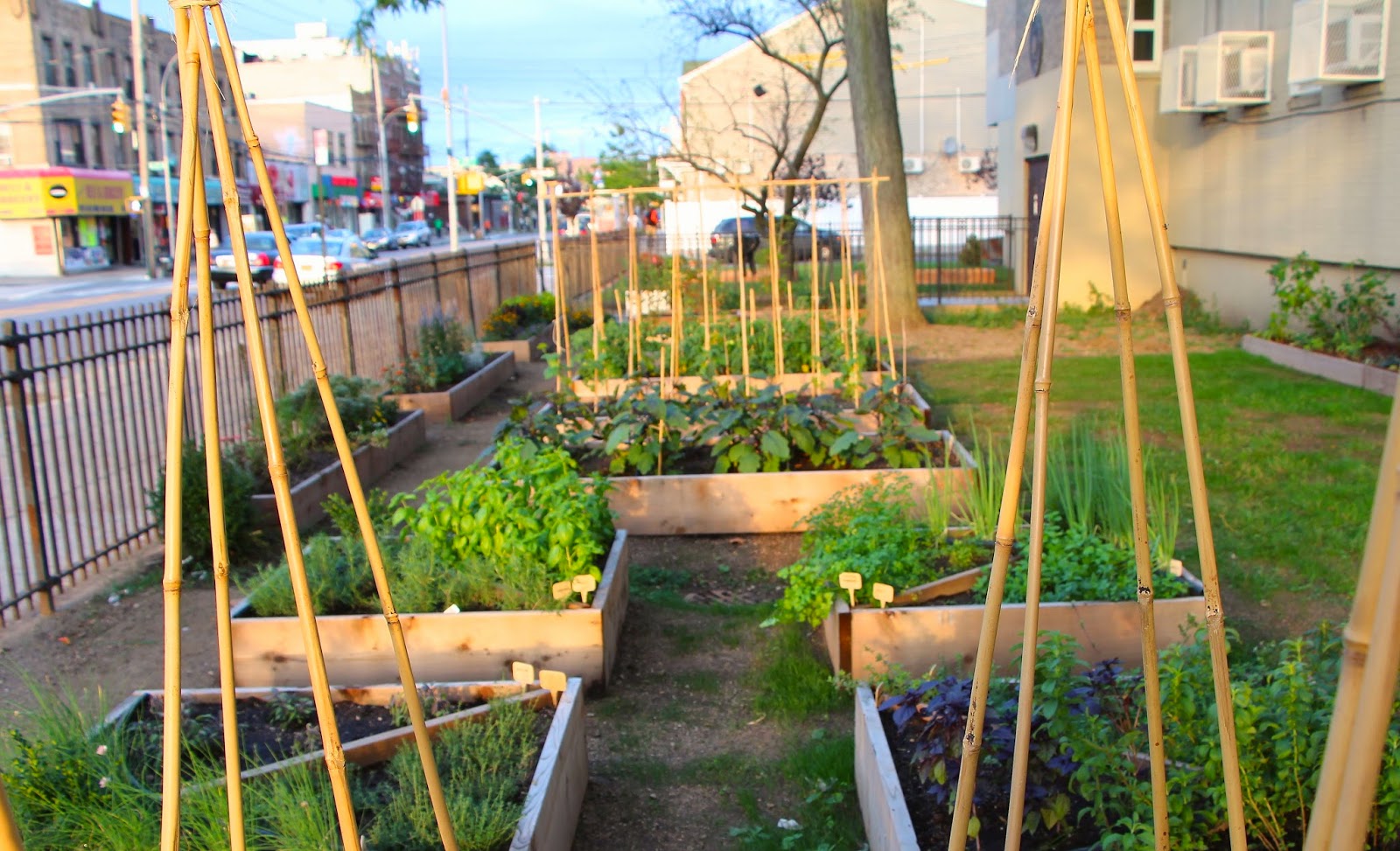
Yet, growing food from seed and creating a vegetable garden from scratch was truly new territory. With a limited budget and no professional crew to construct and layout the beds, I became a contractor. I instructed three (often reluctant) teens to help with the construction of twenty raised cedar beds for a vegetable garden at P. S. 329 in Coney Island. Leveling the ground and lining up all the beds required patience and lots of elbow grease. Several pairs of hands were needed to haul twenty-six yards of soil from the sidewalk, over the fence and into the planting area to be later added to the beds. It was a tremendous and arduous task and I think my body is still recovering from the rigor of it all.

A clearly delineated lawn area was created between a long shade border against the school building and the vegetable beds. I imagine one day the lawn will be laid out with cloth-covered tables and dozens of children will be serving each other and enjoying their harvest. That border was filled with shrubs and perennials to be used as teaching aids and to add winter interest.  Many of those shrubs, hostas, ferns and Ajuga reptans were schlepped  from the garden near my home in Harlem. Dozens of earthworms were also dug up and relocated on the two-hour trip by train to Coney Island. They were a welcome addition since salt water from Hurricane Sandy wiped out the earthworm population. The kids added them to the soil one at a time, squealing all the while. Garden beds closest to the sidewalk contained native and pollinator-attracting plants like agastache, salvia, rudbeckia, liatris, zinnia, marigolds and nasturtiums and others to be used in basic plant science and Botanical Latin lessons. The plan was to inspire kids to love words along with gardening with plant names like Pulmonaria saccharata, Hydrangea macrophylla and Gleditsia triacanthos (two mature trees grow on each end of the long garden space). Another area was reserved for a three-bin compost, to be built later and surrounded by bark mulch that was to also line the paths between the beds.


    Pizza-shaped herb beds sit between rows of longer beds

Planting started late, about a month later than I would have liked but it was imperative to have the permanent structures laid out well, an often overlooked or trivial element in many school and community gardens.


                                                        Joe Eck-inspired trellis at far end


It is very gratifying to grow food that can be eaten raw or cooked within minutes after picking; food grown from carefully selected seeds or plugs and in soil that it tilled and modified by your own hand. It is also very rewarding to feed the ones you love using fresh, wholesome ingredients, knowing that you are present and monitoring their growth from seed to the table. I must admit that I become very excited about observing the various stages from seed to fruiting, sniffing, pinching and tasting along the way. As quickly as bean vines scrambled up the bamboo tee pees it became clear why children flourish from observing and participating in growing food. A seed, some soil and sunlight and what unfolds into tasty good things to eat is science and magic. Birds loved the baby spinach, mesclun mixes and munched on the leaves of radishes, Brussels sprouts and beets. Strawberries and blueberries were devoured by wildlife and although I never saw them, I was told that raccoons visited regularly after sunset. It was all alright. There was food for everyone. Just as the lawn seeds began to sprout, pretty yellow flowers covered the zucchini and squash, tomatoes started blushing and eggplants grew long and glossy, I left that garden to start another at a school just a few blocks away.

I recently attended classes in teaching gardening and cooking at the Edible Schoolyard. The programs are models and great examples of what can be achieved when staff and administration work together to improve the quality of education and overall health of children through interaction with nature. There you will find a dedicated group of garden and cooking instructors working in an awesome garden and state-of the-art kitchen. I am a novice and I gather knowledge from the professionals at the Edible Schoolyard to master the art of educating children at P.S.188. Under a couple of four-foot grow lights we started from seed various types of tomatoes, peppers, eggplants, squash, zucchini, beets, corn, cucumbers and okra. Oregano, bunching onions and basil were started under lights in my bedroom. We also sowed seeds of hyacinth beans, Mina lobata, marigolds, lots of nasturtiums and the very sensitive sensitive plant. Can't wait to taste our heirloom tomatoes and have kids create salads that include nasturtium and marigold flowers.


             Tomatoes, Corn, Peppers, Okra and Oregano started from seeds under grow lights


 A gardener's hands


 Seemingly wild and wickedly wonderful flowers in Jeff's garden


Snapdragons growing happily with kale


                                                                      Jeff in his beautiful garden

I am constantly gobbling up information from vegetable garden books, catalogs and vegetable garden bloggers. With zany, brainy children I am planting up a storm, gaining experience as a vegetable gardener and enjoying teaching. Whoohoo! Soon I will plant my very own vegetable garden, one in which I will even tackle growing asparagus and artichokes. I also continue to rely heavily on words of wisdom from garden experts like Jeffrey Farrell, Wayne Winterrowd and Joe Eck. They have given me much to emulate and much to admire. I owe them gratitude and many, many thanks.

Spring, Sun and Stars

Garden design and gardening are components of what I do for a living. It is the perfect career because I have a passion for plants, trees, ecological design and botany and because I enjoy being outdoors. I also design and garden for others partly because I do not personally own a space to garden. My apartment lies on the forth floor with windows that face east, west and north. Eleven altogether. Four narrow window boxes of herbs, ivy and and annuals can be called my own. However, there are other apartments with walls twenty feet away running parallel to my windows, limiting sunlight. If I am lucky I can see through my east-facing windows through the windows of the nearby apartment and possibly get a glimpse of a planetree (Platanus acerifolia) in the adjoining community garden area. Of course I do the gardening in that garden. Lots of dollars and countless hours go into making it a beautiful space that also serves as a plant laboratory. This space, while having enough light to enable a range of plants, shrubs and trees, has only limited sunlight since it is, like my apartment, cradled by nearby structures and erroneously planted with five London planetrees and three callary pears (Pyrus calleryana), each year growing wider canopies, scraping the sides of buildings and hogging the sun. How landscaping companies continue to get away with such obvious and inexcusable mistakes of crowding too many trees in tight spaces and too near to buildings is beyond me and a topic for a later post.

With some success (success is a relative word since I do get some floppers) I grow grasses: a few varieties of miscanthus, Calamagrostis brachytrica, chasmanthium and hakonechola. Struggling along are echinacheas, monarda, geraniums, buddleia and Salvia garanitica. Hydrangea macrophylla thrive in this garden and I grow many in shades of deep pink, soft pink and white to green. A red sand cherry and variegated red-twig dogwood are tall members of the group of plants along the north side. Polygonatum odoratum, autumn ferns, astilbe, ajuga and pachysandra cover the ground near the Japanese maple (Thank you Peggy), boxwoods, witchazels, laurels and pieris. The sunniest areas are home to roses, a star magnolia (to celebrate the life of super cat, Mr Nuit); a few floppy heleniums and panicum, almost-always-flowerfless baptisia and Aster frickartii 'Monch', which is a lovely and floriferous recent addition, despite the flopping. I've learned to treat eryginum, coreopsis and achellia as annuals and I cherish every leaf on my lamb's ear, protecting it from excess water and fussing about this and other plants each winter. I ferociously fight fungus and mildew. Like a photographer with slow film, no flash and limited light, who pushes his film and moves his subject to more available light, I push sun-loving plants by diligently supplying all their (other) growing conditions and tweak, coax and manipulate them to stand up or to produce flowers. I remove overhead branches, pinch and deadhead rigorously and rejoice when I am rewarded with color in the garden.

The dilemma of the city gardener is desiring to grow a range of plants that require more than the available pittance of sunlight found in many residential gardens. Of course if you grow on your rooftop or southwest facing balcony the chances are that you have more sunlight than most and while I envy you I know that I long for a space that affords both soil in the ground and an abundance of sunlight that can allow me to live out my fantasy of growing multitudes of fiery and fiercely colorful plants. My situation is not unique. Certainly other New York City gardeners get tired of plantings of boxwood, ivy, hostas, wax begonias, liriope and coleus. I want to grow burlesque dahlias, fat-faced sunflowers and a long list of sun-loving plants like Echinops ritro, Eyginum yuccifolia, a carnival of heleniums, bee-enticing agastache, Crocosmia lucifer, salvias galore, burgandy cotinus, feathery foeniculums, sultry Sedum matrona, tall rudbeckias and delicate but magnificent poppy. I never hesitate to take on a project that affords an opportunity to design with such plants and I feel extremely fortunate that a few sun garden projects have come my way lately.


                                                   Sunflowers at PS329 in Coney Island

One such design was for a British poet and his writer partner who live on the corner of West 123 Street in Harlem; "corner" being the key word. The small garden space faced the east side of a large re-purposed synagogue which sat cross the street from a public park on the east. I salivated at the thought of sunlight from the south and east for a chunk of the day and a bit of sun from the west on the southernmost corner to make a dramatic display of grasses, umbels and erect seed heads as the day ends. A carefully chosen list of plants was prepared while leaving room for spontaneity and last minute purchases like delphiniums, deep red euphorbias and the annual passionflower vines that caught my attention on my trips to nurseries. Robust red ricinus, brilliant nasturtiums, rosy dahlias and irises were included along with a varied palette of perennials and grasses like stipa, miscanthus, panicum, calamagrostis and molinia. I found Black and Blue Salvia guaranitica and a bright blue salvia. A pale blue version was impossible to find, but I had a patch in the garden near my apartment if I needed to pull some.

All were to create drama and pizazz without being garish in a garden that said "Here We Are", the phrase of the owners who were intent on making their presence felt amidst much struggle to secure community acceptance of the ownership of the building they were restoring and calling home, and what an extraordinary and beautiful home it would be.

Blue asters were to weave their way through the garden in fall along with monarda, sedum, croscosmia and eupatorium seed heads and late blooming heleniums. The design included three upright Euonymus "Manhattan", selected for their tried-and-true performance in other gardens I had installed in Harlem and for year-round greenery when frost turned plants to mush or were cut back. As with other garden designs I would have liked to keep the grasses uncut to create winter interest and contrast against the evergreen euonymus. The grasses would also create movement and with seed heads from flowering plants provide food for birds throughout the winter months, like the cardinal that sang beautifully in a leafless pear tree just a few feet from the garden while I measured in early spring. With about eighty-five percent of plants already in the humus-rich soil and labels in bare spots awaiting plants on the way, the owners informed me that they wanted to continue the planting themselves.


The result is this, or rather the result was this. I designed and installed the garden in spring 2013 and my enthusiasm never waned despite the fact that I knew the owners considered this first installation as an experiment, a temporary garden design; the first in possibly a series of gardens planted each year. One of the owners is the author of a book on growing a garden from seeds. I should mention that the soil was a mere twelve to fourteen inches deep and the garden sat on a roof of a "wet room" on the building's basement. There were plans to replant the space in the fall, so as far as I know, this garden, an opportunity to create an urban garden in the sun, may no longer exist.

Oh well, alright. It's alright. I keep dreaming. Here comes the sun, again and again; not a moment too soon.

Oh My Love, My Darling: Teak


Teak is the first tree that I came to love. Since then there have been many others; Magnolia, Bois canot, Poui and tall bamboo may try to compete but teak will always have a special place in my heart. I don't exactly how or when it started but I remember always anticipating the encounter as the taxi or bus approached rolling fields with bison and the arches created by fields of teak on both sides of the road between Tableland and New Grant. I stared making drawings of teak leaves and its papery thin-skinned fruit when I was a teenager. At sixteen I dreamed of lying in a grove of towering teak and falling asleep upon a bed or curled leaves. I ruminated about teak. It became my obsession and muse.

Teak (Tectona grandis) is a fast growing hardwood tree, the trunk of which can grow to seventy feet in just ten years. A native of Burma, India and cultivated in the Caribbean, it is grown for making fine (and wasted on not-so-fine) furniture. Teak is long-lasting and thus expensive. Men have lost their lives protecting mature trees against timber robbers. It is the wood most often used to make planters, outdoor furniture, decks and boats.


In 1988 when I left Trinidad to study art in Kingston, I found myself constantly drawing leaves. I made paintings of an aging Eudora Welty staring into the distance with dried leaves suspended in the air around her. Leaves were curling and falling singly and in groups all around me. It took a while before I realized that I was homesick and missing the fields of teak that I passed to and from school and work for the previous years of my life. Leaves dominated my paintings and were carved into my pottery. They came to symbolize the passage of time, change and longing.

TEAK
It is you I adore. I can count the whys:
For the way your trunk stands erect, like the queen's guards
Ushering me along the winding road to town
Verdant fields with bison behind you. Is that envy in their eyes?
It is because you are fine in grain and core
No architect could possibly love you more.

Is it because I know now, what I only guessed then
That you are treasured for strength and resilience
Growing more handsome as time goes by
Coveted and consumed almost to the point of extinction.
As a currency you are more precious than gold
Proof that money grows on trees.

For airy clusters of flora and fruit, halos above your head
Like so many bees suspended in awe.
It is for your tender leaves, with pubescent undersides,
The largest in all the land
And when they die, they die so beautifully;
Curling and twisting on the way back to earth.

I long to mimic those country roads
And create an alley of you that no axe will ever near
You stand august, while we come and go
Making fools of ourselves being humans beings.
You are all that is good and beautiful.
You are forever pure, forever royal, and forever. 

A Winter Whine

I consider myself a New Yorker, having lived in Brooklyn for thirteen years and Manhattan for ten: almost half my life. I love it here! New York is where my boys were born and have lived all their lives. They will always call it home as will I. Yet, each year when this horrible winter cold takes a hold I start thinking, I want to go Home. Home to the place where I was born and home where I often think I belong.

But what would spring be without winter? Would our spirits be lifted by the sight of jonquils if we had not endured weeks of miserable cold? Narcissus, tulips, crocus, alliums and scilla all need the cold period before warmer, wetter weather prompts them to pop up. Do I need the winter cold? I understand that gardens and plants need the winter months as a time to rest. Or do they really? Maybe it is just that they are forced to rest and do as mother commands. So they adjust, they adapt, they must or they die and some die despite it all. Blankets of snow are often insufficient to protect some from desiccating winds, freezes, thaws and freeze again that make them heave and me want to bolt. Rest can hardly be restful if plants are fighting for their lives, even under blankets. When I look out at my widow boxes with frozen ivy and rosemary I wring my hands wondering what perennials and shrubs will succumb to the perils of winter this year. I hear the fading cries of a certain stray cat and wonder if he will make it. Will the cold kill all the pests that torture a gardener? Would that it destroyed adult and eggs of the nefarious tick. Now that's something to not whine about.


Maybe my beef with winter is the same as yours: it is too long and I cannot simply occupy a state of hibernation throughout it. Can I? Can I be as dormant each winter as the garden itself, staying in the great indoors, living off soups and mugs of tea while writing, drawing, obsessing over seed packets, plant catalogs and plans for the new year and pretending I can play guitar, under layers of wool? Instead I schlep. I freeze. I shiver and swear on above-ground train platforms and risk breaking my back on deceptive patches of ice as I race around town in order to bring home the bacon (or broccoli).

Forget this bloody freezer! Rather than weathering the weather take a cue from the hummingbird: head out of hell and stay south until the end of February. Each winter I want to go home to my cricket-commentating, gospel-singing, Sinatra-whistling, bird-watching parents and work with my mom, happily pulling weeds from between orchids and anthyriums while lizards and praying mantises wait patiently to snatch butterflies from the lantana bush. I will hear kiskadees singing on the electrical wires and that bird that makes a song like tweet-tweet-double-tweet-tweet-doy-doy-doy each morning. I want to be woken up by a rooster at 3:55am, say "What the hell?" and go back to sleep. I will hear the rain thundering on the rooftops and collect muddy passion fruits that were washed off the vines. Being able to garden all year long is something to not whine about. It is to sing about, indeed.

And what of an endless summer? Were I to retire to a tropical island I would surely miss seeing ice embracing thin branches, icicles hanging from awnings and bumpers and ice crystals kissing the glass door entrance of my building and window panes. I would think of fresh and falling snow creating soft mounds on stoops, obscuring garbage bins and making Boteros of each line on the fire escape. I would miss the fleeting magic of the New York City wonderland, made more magical during the holiday season. I would want to watch as my boys speed down the slopes while I imagine that one day I may be good at cross country skiing. I would long for the winter landscape with seemingly infinite layers upon layers of leafless branches punctuated by the surprising chartreuse twigs of the willow, both beautiful and haunting. I would want winter walks in  the countryside, cardinals against the snow and sledding in Central Park.


So I try not to whine. I enjoy each winter's day that feels like the beginning of spring, like yesterday, with sun shining and the air crisp. I stay indoors when I don't have to be outside. Then some days, like today, it was great to be outside. The snow was heavy, perfect for making easy snowballs. I bowled and hit tree trunks as my wickets. These images were taken in Jackie Robinson Park in Harlem. 


I hope some day, maybe sometime during another twenty-three years or so, I will adjust like the rosemary bush in my window box, standing intact after the last frost. One day when yet another cold season rolls around I will say "Bring it on" and be confident that I will emerge a little stronger, a bit more resilient and better equipped for all the winters that lie ahead.

Snow Birds

Two mourning doves (Zenaida macroura) discovered my window boxes last summer. I encouraged them with old cat food cans filled with birdseed and they became regular visitors.


 Last winter I was surprised and thrilled to discover that a pair of juncos had taken up residence in my window boxes. The dark-eyed juncos (Junco hyemalis) were probably attracted to the berry-covered branches of Ilex verticillata that protruded from the boxes and evergreen branches that I placed on top as mulch and winter decoration. Several feet of well established English ivy hung from the boxes and the birds slept in the shadow of the leaves, their dark bodies concealed. One of the two boxes sat near my kitchen and was protected from strong winds by a sort of cul-de-sac created by the external walls of my apartment, the building's staircase area on the south and the apartment to the east of mine. From what I've read about juncos they are mostly ground dwellers. However, my apartment is on the forth floor. The sheltered area may just be a perfect hideout and protection against strong winds.


Called Snow Birds, juncos spend most of the year north of New York but the city is their preferred home for winter months. Although I rarely saw them together in the same box I knew they were a couple. The bird I identified as the female slept in the hanging ivy of the window box closer to the north that was more exposed to sun and wind. Last fall that box also contained a rosemary bush, thyme and lysamachia. I was careful not to disturb the birds as I walked past the windows in my living room and I kept watch over my furry companion, Mr GiGi, as he got exited about their presence. As is the habit of juncos, the birds headed north to Vermont or Canada as winter ended.

Just the other day I was startled then delighted and a second later, horrified, when I realized that the sudden movement outside my window was that of the juncos. They had returned. However, because of ongoing construction work on the exterior walls and roof of my building I had removed the box on the south side and the box on the north was void of all plants except for a tallish galingosoba weed, pieces of concrete, brick and chipped paint; nothing that would inspire juncos to spend the evening. The next day I planted some ivy and vinca minor and placed bird seeds. I waited for about two weeks but saw no birds, until just a few days ago.Yayyy!

While I sit with my laptop or drawing board there is often movement between the parted curtains. I watch as they take turns picking at seeds while the other may be nearby scratching in the snow.  Native grasses and perennials will be added to the window boxes next spring and never again will they be without hanging English ivy and other plants to attract birds. Who knows what other birds may pop up to frustrate and entertain Mr GiGi and create welcome and happy little distractions throughout the seasons.
 

Happy Holly Days!


Kids, all kids are brilliant and inspiring. They can be so much fun and funny with their eager faces brimming with curiosity. Then they have me pulling my hair out or they are pulling each others' hair out while tripping on bags and shoelaces. I work with children at PS188. Over the past few months we've collected and eaten tons of seeds, gutted pumpkins, sung songs about trees and inchworms measuring marigolds; made leaf-shaped cookies, pricked our fingers on junipers and squished berries. As part of our classes about trees, shrubs, healthy eating, the environment and gardening (without having a garden) we talked about the importance of evergreen trees and shrubs in the winter landscape as habitat and food for non-migrating birds.


Juniper berries are attractive. Cones on pines, spruces and firs are emblems of the winter. However, no plant says Holiday Season like holly. Birds depend on holly and juniper berries and seeds from cones when the ground is frozen or covered by snow as chances of finding insects and worms are slim.


With deciduous trees truly bare and some snow sitting on the ground and rooftops of Coney Island, our lessons become more than just theory. Next spring we will plant Ilex verticillata as part of our habitat-pollinator-eco garden. Ilex verticillata makes the showiest display of berries but Ilex opaca combines berries with lustrous evergreen spiny leaves; all interesting shapes and colors to attract hungry birds. It is the most popular choice for holiday cards with kids.

This New Year may your days be berry and bright and may your life and gardens be filled with joy and happy creatures in flight!

AFRICAN RICE IN NEW YORK

  While standing in the long line outside The Hungarian Pastry Shop near Columbia University, I was approached by a man who asked if I could...